The Ontario government’s designation of Kinross Gold’s Great Bear Project under the One Project, One Process (1P1P) framework is a landmark moment — not just for Kinross, not just for the Red Lake region, but for Canada’s broader ambition to assert its mineral and economic sovereignty on the world stage.
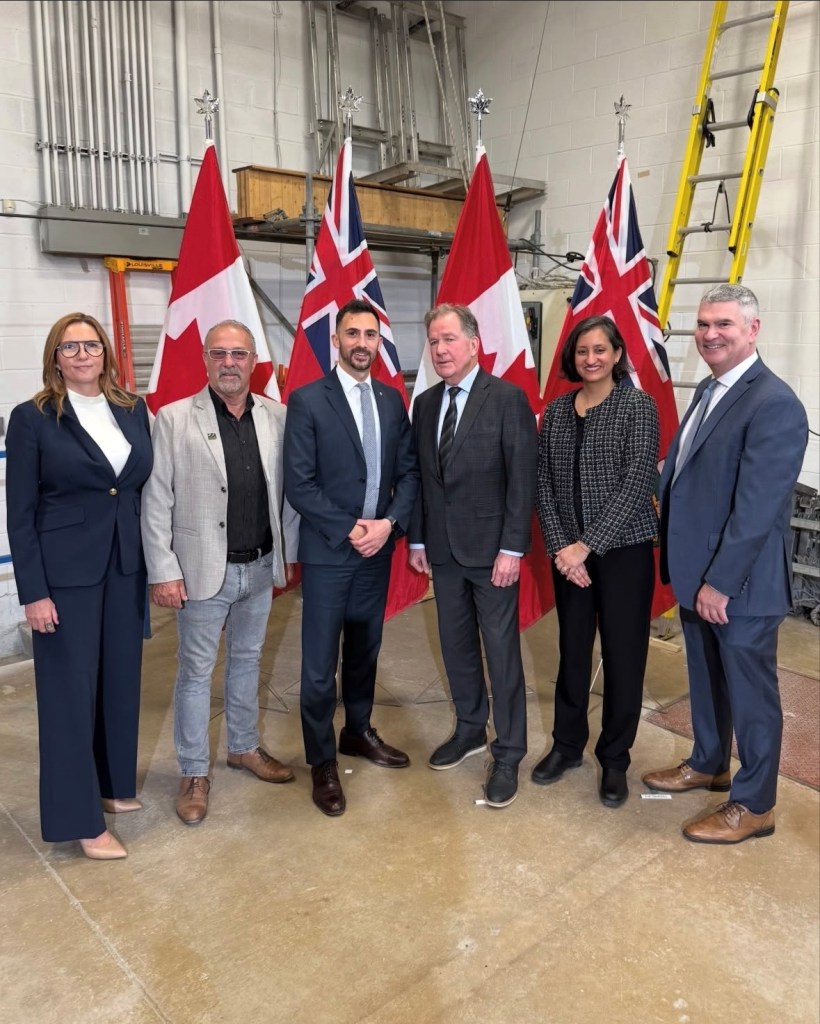
Marla Tremblay Executive Director Mine Connect
Mayor Rick Dumas (Marathon)
The Hon. Stephen Lecce Minister of Energy and Mines
The Hon. George Pirie, Minster of Northern Economic Development and Growth
Ontario Mining Associatin President, Priya Tandon
Let me be direct: this is exactly the kind of decisive, coordinated government action our industry has needed for years. A project of this magnitude; a $5 billion capital investment, over 1,000 jobs at peak employment, and the potential to produce more than 500,000 ounces of gold per year deserves a permitting regime that matches its scale and strategic importance. By cutting government review time by up to 50 per cent and designating a single point of accountability, Ontario is sending an unambiguous signal to global markets: this province is open for business, and it knows how to get things done.
But I want to go further than celebrating what’s in front of us. Because as someone who has spent much of my career in the exploration and prospecting community, I feel an obligation to ask the question that often gets lost in the excitement of a major project announcement: Where does the next Great Bear come from?
The Pipeline Is the Point
Great Bear didn’t materialize out of thin air. It was born from decades of grassroots exploration — the kind of patient, high-risk, boots-on-the-ground work that most people never see and rarely celebrate. Geologists, prospectors, and junior mining companies working with modern geoscience data, Indigenous knowledge, and sheer determination are the reason Ontario has world-class projects to fast-track in the first place.
This is the part of our industry’s story that I believe deserves far more attention in the policy conversation. The 1P1P framework is an exceptional tool for advancing projects that have already crossed the discovery threshold. But the pipeline that feeds those projects; the grassroots exploration stage requires its own sustained attention, investment, and policy stability.
Investments in exploration pay strong dividends. The PDAC tell us that every dollar invested in Canada can return double that investment in direct and indirect contributions to local, regional, and provincial economies. And while not every project is a winner, we’re in a quantity game right now in the global race to secure deposits.
Think of it this way: you cannot fast-track what hasn’t been found. Every mine that Ontario will permit in 2035, 2040, or 2050 depends on the exploration work being done (or not being done) today. If we allow that pipeline to thin, no amount of regulatory efficiency will fill the gap.
Mineral Sovereignty Is an Active Pursuit
We are living through a period of unprecedented global competition for critical and strategic minerals. Nations are scrambling to secure their supply chains, reduce dependence on geopolitically unstable sources, and build the resource base needed for the clean energy transition. Canada, and Ontario in particular, is extraordinarily well-positioned to lead in this environment. We have the geology, the talent, the infrastructure, and increasingly, the regulatory framework to compete at the highest level.
But mineral sovereignty is not a passive inheritance. It is an active pursuit that must be continuously renewed through exploration investment. It requires modern, accessible geoscience data so that prospectors and junior companies can identify new targets. It requires meaningful exploration incentives both tax-based and grant-driven that de-risk the earliest and most capital-intensive stages of discovery. And it requires policy stability: the confidence that the rules of the game will not change mid-play, that access to land will be maintained, and that the regulatory pathway from discovery to development is clear and navigable.
When those conditions are in place, Ontario’s prospectors and junior explorers will find the next Great Bear. When they are not, those opportunities, that capital, those jobs and that tax revenue move elsewhere — or disappear entirely.
A Generational Responsibility
The Great Bear Project has been described as a generational asset. I believe that phrase carries a deeper obligation than it might initially suggest. A generational asset is one that previous generations worked to discover and de-risk so that today’s generation could develop it. Our responsibility, in turn, is to do the same work for the generations that follow to invest in discovery now so that future Ontarians inherit a robust pipeline of world-class opportunities.
The OPA applauds the government’s leadership on 1P1P, and we are committed partners in making frameworks like this work. We will continue to advocate vigorously — to government, to the public, and to the investment community for the exploration incentives and geoscience investments that keep Ontario’s discovery engine running.
Because the mine you open today is only as good as the deposit you find tomorrow.
Ontario has proven it can build world-class mines. Now let’s make sure we never stop finding them.
Steve Virtue is the Interim CEO of the Ontario Prospectors Association (OPA), which represents the interests of prospectors, junior mining companies, and exploration professionals across Ontario.
 Help, is on the way
Leave a comment