The Year That Was, 2025
As the mining industry concludes 2025, the sector faced a confluence of pressures that tested even the most resilient operators. Forward-looking analysis anchored in real-time data had shifted from luxury to necessity, as risks evolved with disconcerting speed. Strategic oversight had to operate in lockstep with operational teams, adapting to conditions that shifted by the quarter, if not by the week.
Political upheaval, from elections marred by disinformation campaigns to the cascading consequences of Middle Eastern conflicts, injected fresh volatility into investor sentiment and operational environments alike. The resulting uncertainty extended beyond immediate security concerns, reshaping the social licence that mining firms required to operate and influencing the investment climate for an industry already navigating treacherous waters.
The Capital Crunch
Capital availability emerged as mining’s paramount risk, with the International Energy Agency projecting that achieving net-zero targets by 2050 would require investments in energy transition minerals of up to $450 billion by 2030 and $800 billion by 2040 (UNEP). This demand for capital arrived precisely when companies had to balance growth ambitions against discipline, as minerals critical to energy transitions faced surging demand. Just 4% of survey respondents believed current support measures for the sector in OECD countries were adequate to support investment (White & Case LLP), underscoring a yawning gap between aspiration and reality.
Environmental stewardship commanded heightened attention as regulatory scrutiny intensified and societal expectations for ecological responsibility hardened. Yet it was geopolitics that cast the longest shadow over the sector. Over 33% of copper production occurred in “very high” and “high” risk countries, up from 17% in 2016 (Verisk Maplecroft). Resource nationalism, once confined to a handful of jurisdictions, had spread like contagion. Mali required mining companies to process 20% of gold production domestically by 2025, rising to 35% by 2030 (Discovery Alert), while the Democratic Republic of Congo temporarily suspended cobalt exports in early 2025 to stabilise prices (China-Global South Project). Such interventions, combined with export controls and tariffs, exposed the fragility of mineral supply chains concentrated in geographically limited regions.
The Operational Grind
Beneath these macro pressures lay operational realities that compounded daily challenges. Global average copper ore grades were projected to decline by over 30% between 2000 and 2025 (Farmonaut®), forcing companies to process vastly more material for equivalent output. When combined with rising input costs and aging infrastructure at deeper mines, the burden became formidable. Expected mined copper supply from announced projects fell short of projected demand in 2035 by 30%, with lithium facing a 40% deficit (IEA), suggesting structural constraints that technology alone struggled to overcome.
Further, social unrest and organised crime presented tangible threats in Latin America and parts of Africa, complicating efforts to maintain consistent operations. Last year, the economic impact of violence reached $19.1 trillion, or $717 billion higher than the previous year.This came as conflict deaths hit 25-year highs, and wars continued in the Ukraine and Gaza. In response to heightened geopolitical tensions, European nations have injected billions into defense spending. Even Japan plans to double its defense spending to 2% of GDP
Meanwhile, cybersecurity risks escalated as mining became increasingly connected. Evolution Mining experienced a ransomware attack in August 2024 that impacted its IT systems (Taylor & Francis Online), whilst ransomware attacks in mining were projected to increase by 40% annually (Farmonaut®). Global ransomware attacks against critical industries surged by 34% in 2025 (Industrial Cyber), with mining squarely in the crosshairs. Such intrusions threatened not merely data but production continuity, as attackers increasingly targeted operational technology alongside information systems.
Adaptation or Atrophy
For mining companies, 2025 demanded agility rather than inertia. Advanced technology, ranging from artificial intelligence optimising extraction to satellite monitoring tracking environmental impacts, offered pathways through complexity. Workforce development had to address critical technical shortages, whilst proactive community engagement could buffer against social licence erosion. Yet technology and goodwill alone did not suffice. Sixty-seven percent of respondents believed Trump’s expected policy agenda would raise costs from supply chain fragmentation or slow investment from uncertainty (White & Case LLP), illustrating how political winds could scatter even well-laid plans.
The mining industry had weathered disruption before, emerging stronger through cycles of boom and bust. But 2025’s risk landscape differed in its interconnectedness and velocity. Companies that recognised this new reality, and invested accordingly in resilience, relationships, and reinvention, navigated the turbulence. Those that clung to outdated playbooks found themselves casualties of an unforgiving era.
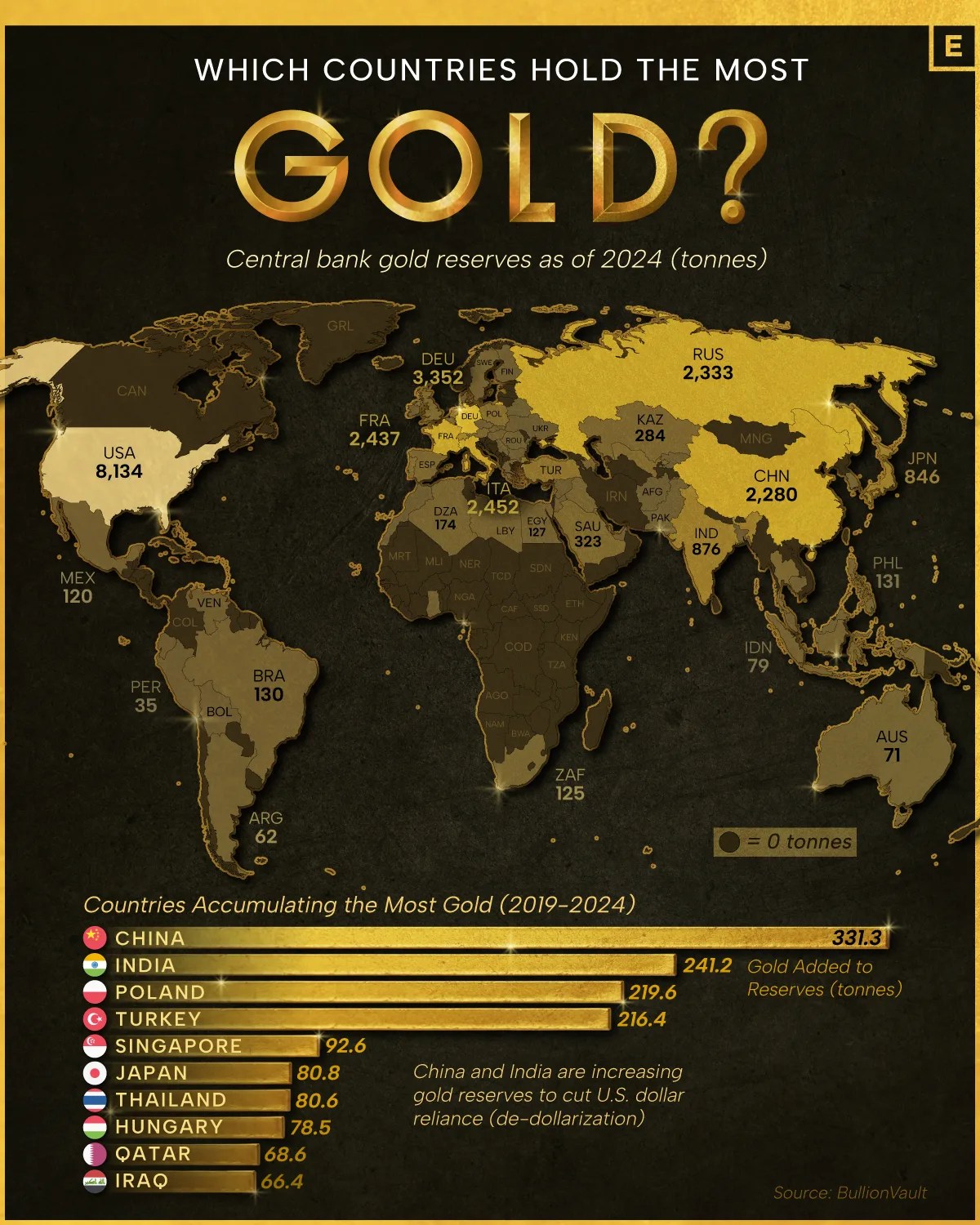
#VisualCapitalist
 Help, is on the way
Leave a comment